
How We Keep Your Tinyhat AI Computer Private and Secure
How Tinyhat isolates your Hermes Agent, protects credentials, limits access, and keeps your AI computer separate from your personal devices.
Over the past few months, I talked with more than a hundred CEOs and founders, and almost all of them wanted the same thing: to put AI to work inside their business. Two things kept getting in the way.
The first was security and data privacy. By a wide margin, that was the number one concern. Where does my data go, who can see it, and what happens to it once an AI agent is in the loop? The second was simpler and just as common: people did not know where to start, or how to let their team use AI in a way that felt safe.
We have a name for how we answer that first concern. We call this a zero trust environment, and we mean it from your side: you don't have to trust us, because nothing is hidden from you. Your agent runs on its own private computer, and you can examine every part of it yourself. Everything below follows from that one idea.
This post is about that first concern. Here is how Tinyhat is built so that your agent, your data, and your keys stay yours.
The one-minute version
1. You get your own private computer. Not a shared account, not a slice of a bigger machine. your own isolated Tinyhat computer running Hermes Agent that nobody else uses.
2. Think of it like buying a VPS or a Mac Mini and setting everything up yourself, except we hand it to you already wired and ready to go.
3. You have full visibility. Through the Telegram bot you can open a real terminal and run any Linux command you want, so you can see exactly what is happening on your machine.
4. We do not store your data. We do not copy it to our database or anywhere else. The only thing we receive is a heartbeat that tells us your computer is alive.
5. Your API keys live in a secured vault on your own computer. No one but you can read them, including us.
6. All of this is on purpose. Every time we had a design decision to make, we made it the way that protects your trust first.
Your own private computer, not a shared one
The most important thing to understand about Tinyhat is that you are not sharing a brain with other customers. When you set up Hermes Agent on your Tinyhat computer, we spin up a computer that belongs to you and only you. Your files, your context, your work history, all of it sits on that one machine. Another customer's agent has no path to it, and neither does anyone else's.
The closest comparison is something you have probably done before. Imagine you bought a VPS from a cloud provider, or a Mac Mini that sits in a closet, and then you spent a weekend installing the software, connecting the tools, and wiring everything together so it actually does useful work. At the end of that weekend you would have a private machine that is entirely yours.
That is exactly what you get with Tinyhat, minus the weekend. We provide the infrastructure and we do the wiring, so the private computer shows up already set up and ready to use. You skip the plumbing and ongoing maintenance and keep the privacy.
Full control and full visibility
A private machine is only reassuring if you can actually see inside it. So we gave you a way to look.
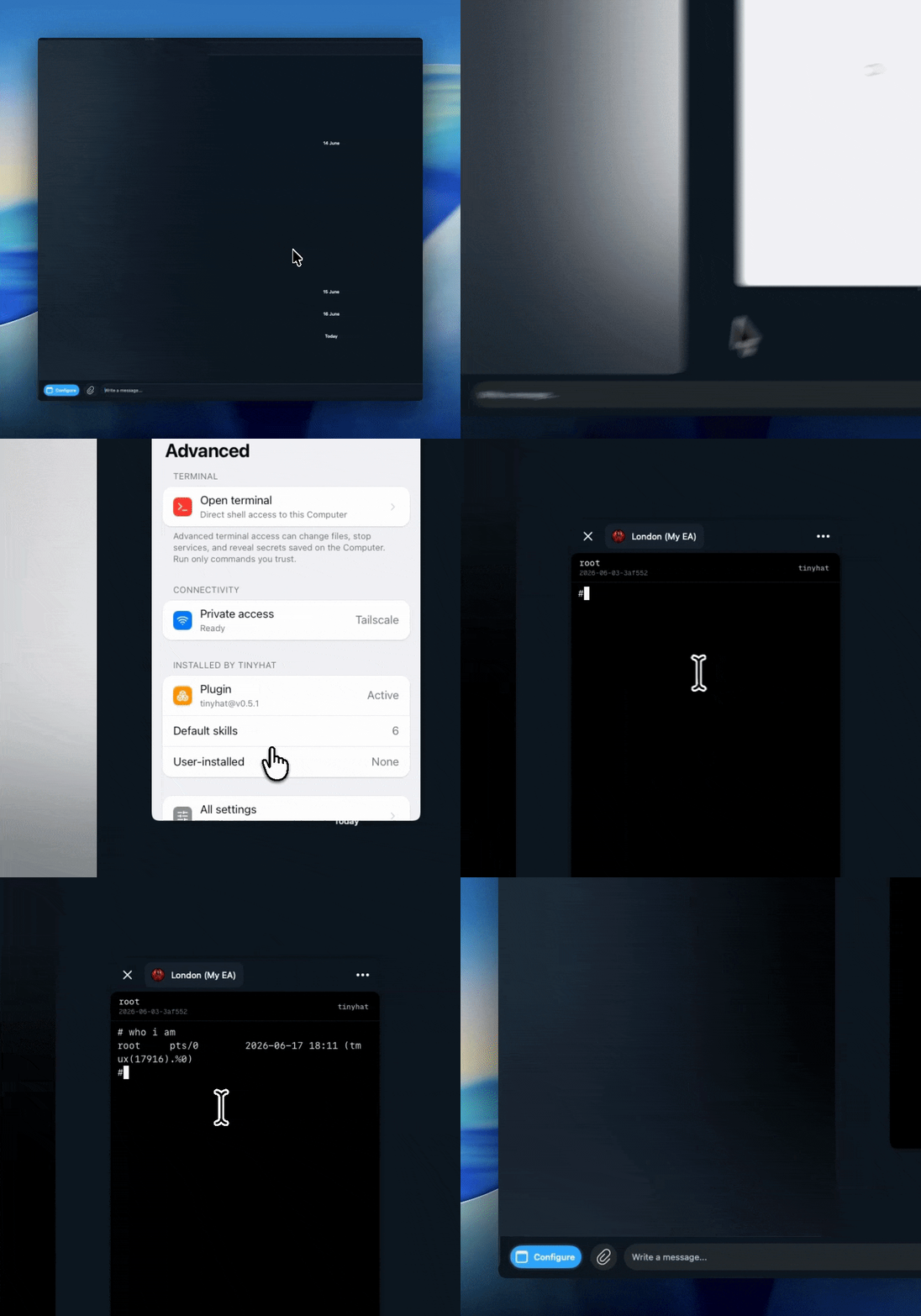
Open your bot in Telegram and tap Configure. That launches the mini app. Inside it, there is an advanced option that opens a real terminal connected to your computer. From there you can run any Linux command you like. List the running processes, check what is installed, look at the logs, inspect a file, whatever you want.
This matters because it means nothing about your machine is hidden from you. You are not taking our word for what is running. You can go in and check it yourself, at any time, with the same tools a system administrator would use.
We don't store your data
Here is the part people are usually most surprised by. Your data does not flow back to us.
When your agent does work, it does that work on your computer. We are not quietly copying your emails, your documents, or your conversations into a Tinyhat database. There is no central store of customer data sitting on our side, because we designed the system so that there does not need to be one.
The one signal we do receive is a heartbeat. It is a small, regular ping that says, in effect, "this computer is still alive and healthy." That is how we make sure your computer stays up and running, and how we catch a problem before you do. It carries no content from your work. It is the digital equivalent of a pulse, not a transcript.
Your API keys stay locked to you
To make your agent genuinely useful, you connect it to tools: your email, your calendar, your drive, and anything else you reach through an API token. Those tokens are the keys to your kingdom, so they get treated that way.
When you connect a tool, the API key is stored in a secure vault on your computer. It is not sitting in a shared Tinyhat database, and it is not something our team can pull up and read. It stays on your machine, available to your agent, and invisible to everyone else, including us.
That is the standard we hold ourselves to. The credentials that unlock your accounts should be readable by exactly one party, and that party is you.
Why it is built this way
None of this is an accident, and none of it is a feature we bolted on at the end. It is the result of a single rule we set early: when there is a decision to make, choose the option that puts trust first.
That rule is why you get an isolated computer instead of a shared one. It is why you can open a terminal and inspect your own machine. It is why we collect a heartbeat instead of your data, and why your keys live in a vault you control. Each of those choices costs us something in convenience or simplicity. We made them anyway, because the alternative is asking you to trust a black box, and that is not a deal we would want to accept either.
If security and privacy are what is holding you back from putting AI to work, that is the exact worry we built Tinyhat to answer. Your agent, your computer, your data, your keys. We just make sure it is all set up and stays running.


Comments ()